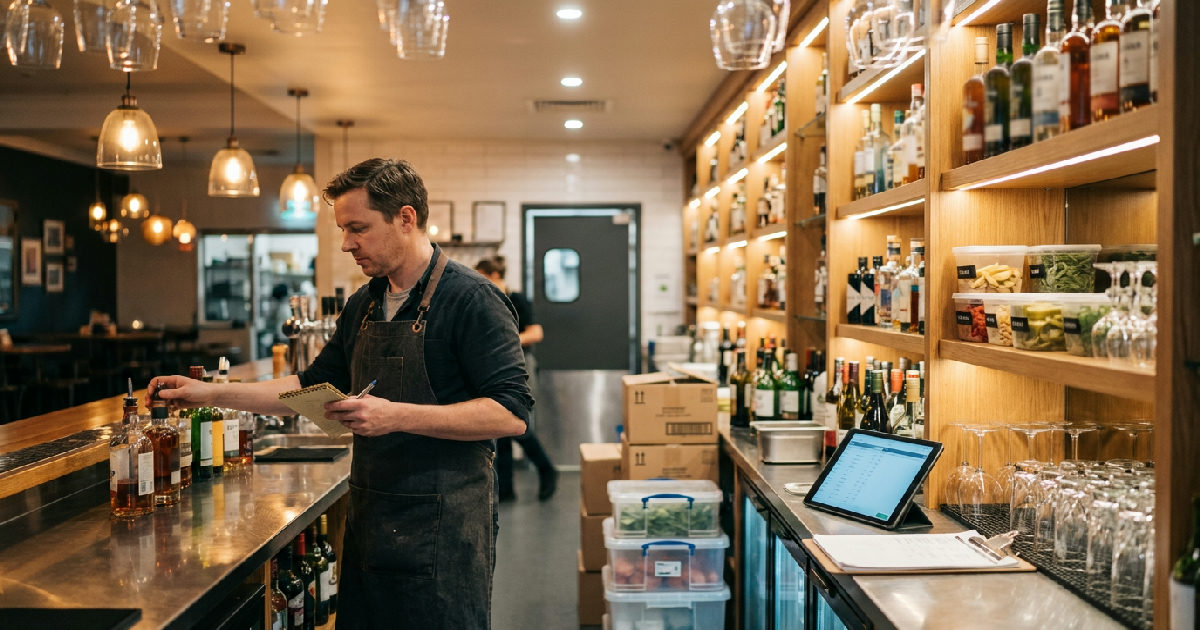
For many operators, ineffective restaurant inventory management is one of the most persistent and costly challenges. Industry estimates suggest restaurants can lose 4-10% of their inventory value to waste, shrinkage, and administrative errors (Source: UKHospitality). In a tight market, this is a direct hit to gross profit.
Properly managing stock is not just about knowing what’s in the storeroom; it’s about controlling the business's single biggest variable expense. This guide provides a practical framework for building a robust system, covering everything from stocktaking fundamentals to exploiting technology for better control.
It covers key strategies for everyone from independent gastropubs to multi-site groups, all designed to reduce costs, minimise waste, and protect your bottom line.
Understanding the True Cost of Poor Restaurant Inventory Management
Experienced operators know instinctively that wasted stock means wasted money. But often, the full extent of the issue—the hidden costs and invisible shrinkage—goes unnoticed until it is too late. It’s more than just what goes in the bin; it’s about missed sales and operational inefficiencies.
Consider the broader impacts:
- Direct Financial Loss: Food waste alone costs the UK hospitality sector an estimated £3.2 billion annually, and around 75% of this is considered avoidable (Source: WRAP). This loss stems from spoilage, over-ordering, and unrecorded waste.
- Labour Costs: Manual stocktakes are notoriously inefficient. For a medium-sized restaurant, a weekly manual count can consume several hours of valuable management time that could be better spent on the floor or training staff.
- Lost Sales: Running out of a popular dish or a key beverage item due to poor forecasting leads directly to disappointed customers and missed revenue opportunities. A pub running out of its best-selling craft ale on a Friday night is a prime example.
- Inaccurate GP Calculation: If stock figures are wrong, Gross Profit (GP) calculations will be skewed. This makes it impossible to correctly calculate your Cost of Goods Sold (COGS) and truly understand menu profitability.
- Supplier Discrepancies: Without a clear system, it's difficult to identify and challenge short deliveries or incorrect pricing from suppliers, which can lead to significant cumulative losses if left unchecked.
How to Calculate Cost of Goods Sold (COGS)
One of the most critical metrics derived from your inventory count is the Cost of Goods Sold (COGS). This figure tells you the direct cost of the stock you sold in a given period. The formula is straightforward:
COGS = (Opening Stock + Purchases) – Closing Stock
For UK operators, it is vital to use figures that are net of VAT. Your opening and closing stock should be valued at their cost price excluding VAT, and your purchases figure should also exclude any reclaimable VAT. Getting this wrong will significantly distort your gross profit calculations. You can learn more in this detailed guide to calculating COGS for your restaurant.
In one operational example, a bar manager implemented a basic inventory system and discovered unrecorded pour waste was costing the venue over £800 a month in spirits alone. What was initially dismissed as 'spillage' turned out to be a combination of over-pouring, unrecorded complimentary drinks, and lack of accountability.
Setting Up Your Stocktaking Process for Accurate Restaurant Inventory Management
A stocktake might seem like a tedious chore, but it is the bedrock of effective inventory management. Consistency and accuracy are paramount. While the process can be arduous—involving late nights in cold storerooms—the operational clarity it provides is invaluable.
Physical Count Best Practices
To ensure accuracy, follow these steps:
- Assign Zones: Divide your venue into logical stock zones (kitchen dry store, fridges, freezers, bar cellar, back bar). Assign specific team members to each zone.
- Standardise Sheets: Use pre-printed stock sheets with item names, units of measure, and count columns. Avoid freehand forms; they lead to errors. For efficiency, consider tools with barcode scanning capabilities.
- Train Your Team: Ensure everyone understands the units (e.g., "1 bottle" vs "1 case of 6"), how to count open bottles (e.g., wet stock measurement guides), and where to record items.
- Cut-off Times: Define clear cut-off times for all stock movements (deliveries, sales, waste) before the count begins. Nothing moves in or out during the count.
- Two-Person Count: Ideally, have one person count and another verify or write down when using stock sheets. This significantly reduces errors.
At one site, for example, a chef would simply write "various vegetables" on the stock sheet. After the team moved to a detailed, itemised list, the first proper count revealed enough potatoes to last three weeks—a direct result of ordering on 'instinct'. This standardisation was key to identifying the specific overstock issue.
Example: Weekly Inventory Audit Checklist
To maintain consistency, a standardised checklist can ensure all areas are covered systematically every time. This reduces errors and makes the process faster.
Zone / Area vs Key Tasks vs Frequency vs Notes
Kitchen Dry Store
- Key Tasks: Count all ambient goods (flour, sugar, pasta, tins). Check date labels for FIFO.
- Frequency: Weekly
- Notes: Ensure all bulk containers are clearly labelled with the product name.
Walk-in Fridge/Freezer
- Key Tasks: Count all chilled/frozen items. Check for spoilage or freezer burn. Verify temperatures.
- Frequency: Weekly (high-value items daily)
- Notes: Spot check weights on proteins (e.g., steaks, fish fillets).
Main Bar / Cellar
- Key Tasks: Count all spirits (using tenths), wine, and unopened beers/ciders. Check keg levels.
- Frequency: Weekly
- Notes: Ensure part-used wine bottles are dated. Check use-by dates on mixers.
Back Bar / Speed Rail
- Key Tasks: Count all open spirits, liqueurs, and mixers.
- Frequency: Daily/End of shift
- Notes: This is a high-shrinkage area; frequent counts are essential.
Coffee Station
- Key Tasks: Count coffee beans (by weight), milk, syrups, and disposable cups/lids.
- Frequency: Weekly
- Notes: Track variance on coffee beans to identify over-dosing or waste.
Optimising Ordering and Suppliers for Better Restaurant Inventory Management
Ordering is where a lot of money can leak from the business. It's not just about what is purchased, but how it is purchased, and validating what is actually received. Experienced managers often spend countless hours negotiating with suppliers and chasing credit notes for short deliveries.
Smart Ordering Strategies
- Par Levels: Set minimum and maximum stock levels (par levels) for each inventory item based on sales history, lead times, and storage capacity. Don't just reorder based on instinct.
- Sales Forecasting: Use your Point of Sale (POS) data to predict future sales trends. Adjust your par levels based on projected covers, events, or seasonal changes. Tools that integrate with your POS can automate purchase order suggestions based on live data.
- Centralised Procurement (for Multi-site Groups): Larger operators can gain significant efficiencies by centralising procurement. This allows for better supplier negotiation, consistent pricing across sites, and simplified oversight. It's a core component of effective multi-site inventory management.
- Supplier Reviews: Regularly review supplier pricing against market rates. Food and beverage inflation has been significant, with recent figures showing an 8.1% year-on-year rise in some categories (Source: ONS), so price checks are crucial.
Delivery and Invoice Checking
This is a critical checkpoint that is often rushed during a busy service. Every single delivery needs to be checked meticulously.
- Physical Check: Count every item against the delivery note. Note any discrepancies (shortages, damages).
- Quality Check: Inspect the quality and temperature of perishable items. Reject anything that doesn't meet your standards.
- Price Check: Compare the prices on the delivery note/invoice against your agreed contracted prices.
- Sign Off: Only sign for what you've received and accepted. Ensure any discrepancies are clearly noted and signed by both your staff and the delivery driver.
Vigilant checking can uncover significant issues. For example, one venue discovered a supplier was consistently short-delivering premium spirits by one or two bottles per order. Over six months, this amounted to over £1,500 in lost stock that would have gone unnoticed without someone checking each individual bottle instead of just glancing at the case count.
Managing Waste and Shrinkage
Waste and shrinkage are the silent killers of profitability. They represent ingredients bought, processed, and then lost before they can generate revenue. Addressing them requires diligence and clear processes.
Tracking and Reducing Waste
Waste isn't just plate scrapings; it's everything from spoilage to staff meals. Proper tracking is the first step:
- Waste Sheets: Implement a waste log for every section – kitchen, bar, front of house. Document item, quantity, reason, and who recorded it. This provides actionable data.
- Portion Control: Standardise recipes and portion sizes. Use scales and exact measures. One head chef discovered actual food costs were 6% above theoretical simply due to inconsistent portioning of high-value proteins by the kitchen team.
- FIFO System: "First-In, First-Out" ensures older stock is used before it expires, reducing spoilage. Rotate stock diligently.
- Staff Training: Educate staff on proper handling, storage, and preparation techniques to minimise accidental waste.
- Repurposing: Get creative with surplus ingredients. Can yesterday's roast chicken become today's sandwich filling?
Identifying and Tackling Shrinkage
Shrinkage often refers to stock that disappears without being accounted for by sales or waste. It can be due to theft, administrative errors, or unrecorded complimentary items.
- Variance Reporting: Compare your theoretical stock usage (based on sales and recipes) against your actual physical stock count. Tools like restaurant inventory management platforms can automate this variance analysis. A 4% variance could be theft, poor counting, or waste, and only detailed analysis reveals the cause.
- Secure Storage: Keep high-value items (premium spirits, fine wines, expensive meats) in locked storage, accessible only to authorised personnel.
- Regular Spot Checks: Unannounced spot checks on key lines can deter internal theft and highlight issues quickly.
- CCTV: Where appropriate, CCTV can monitor storage areas and delivery points.
A café that was consistently showing a high variance on coffee beans introduced daily waste tracking for spilled grinds. This quickly helped identify a training issue with a new barista using too much coffee per shot. It was not theft, but a simple training gap that was costing the business hundreds per month.
Leveraging Technology for Restaurant Inventory Management
Historically, restaurant inventory management meant clipboards, calculators, and late nights with spreadsheets. Today, modern food cost control software has revolutionised this process, especially for multi-site operations.
Manual Spreadsheets vs. Automation: A Comparison
For many businesses, the first step away from pen and paper is spreadsheets. While better than nothing, they still fall short of dedicated platforms. Here’s a comparison for key restaurant inventory management tasks:
Feature vs Manual Spreadsheets vs Automated Platform (growyze)
Accuracy
- Manual Spreadsheets: High risk of human error (typos, formula breaks, incorrect versions).
- Automated Platform (growyze): Minimised error through barcode scanning, POS integration, and automated calculations.
Labour Time
- Manual Spreadsheets: Extremely time-intensive. Hours spent on manual data entry and report building.
- Automated Platform (growyze): Drastically reduced. Stocktakes are faster, and reports are generated automatically in seconds.
Real-time Data
- Manual Spreadsheets: Static. Data is outdated the moment it’s entered.
- Automated Platform (growyze): Live, real-time view of stock levels, costs, and consumption across the business.
Multi-site Management
- Manual Spreadsheets: Very difficult. Requires manually merging multiple spreadsheets, a slow and error-prone task.
- Automated Platform (growyze): Built for multi-site operations. Provides instant, consolidated reporting for the entire group.
Invoice Processing
- Manual Spreadsheets: Manual checks against delivery notes and price lists. Easy to miss discrepancies.
- Automated Platform (growyze): Automated invoice validation flags price and quantity mismatches instantly.
Benefits of Inventory Management Software
- Automation: Automates calculations for stock on hand, usage, and reorder points, saving countless hours.
- Real-time Data: Provides accurate, up-to-the-minute insights into stock levels and costs, accessible from anywhere.
- Invoice Matching: Many platforms like growyze offer automated three-way invoice matching (purchase order, delivery note, invoice), catching discrepancies your team misses during a busy service.
- Recipe Costing: Accurately costs every dish, allowing you to set profitable menu prices and track theoretical versus actual GP.
- Multi-site Visibility: For groups, it consolidates data across all venues, giving directors a group-wide overview of stock, waste, and profitability without spending 3 days merging spreadsheets.
- Reporting: Generates detailed reports on variances, vendor performance, best-sellers, and waste trends, driving informed decision-making.
For operators managing multiple sites, these challenges are magnified. General managers can spend a full day each week consolidating stock reports from different systems. Head office staff then spend further days manually patching them into a group-level spreadsheet, a process riddled with potential errors.
Moving to a unified platform like growyze eliminates this labour-intensive process. It enables GMs to focus on running their venues and provides directors with real-time, consolidated insights with a few clicks. This shift enables strategic management of inter-site transfers, group-wide procurement, and consistent reporting across the entire organisation. The ROI is often realised rapidly through labour savings and waste reduction alone.
Frequently Asked Questions
How often should a restaurant conduct inventory checks?
Best practice is to conduct a full physical stocktake weekly or bi-weekly for all items. For high-value, fast-moving items like premium spirits, fresh seafood, or specific cuts of meat, daily spot checks are recommended to quickly identify waste or shrinkage.
What is the best method for restaurant inventory management?
The most effective method combines regular physical counts ('shelf-to-sheet') with perpetual inventory tracking using software. This approach uses sales data from a POS system to automatically deduct items from inventory as they are sold, providing a real-time theoretical stock level. This is then verified against the physical count to calculate variance.
How can restaurants reduce inventory waste?
Key strategies include implementing a strict 'First-In, First-Out' (FIFO) stock rotation system, standardising recipes and portions to ensure consistency, tracking all waste with detailed logs, and using sales data to create more accurate purchasing forecasts. Repurposing surplus ingredients can also significantly reduce food waste.
Sources
- UKHospitality — UKHospitality Autumn Budget Submission 2023
- WRAP — Hospitality and Food Service (HaFS) sector food waste estimates
- ONS — Consumer price inflation, UK
Take Control of Your Inventory with growyze
Effective inventory management isn't just about counting stock; it's about making informed decisions that directly impact your bottom line. The operational challenges are real – from missed deliveries to unrecorded waste – but the solutions exist.
Platforms like growyze are designed specifically for the complexities of UK hospitality operations, helping operators transition from manual, error-prone processes to a streamlined, data-driven approach. It provides the tools to accurately track every ingredient, control costs, and ultimately boost profits.
Stop leaving money on the table due to inefficient stock control. Reclaim management time, reduce waste, and gain full visibility over your operations. See how growyze can transform your restaurant inventory management by booking a demo today.